By Ko Kyaw Wanna
We live in an era dominated by a certain class of educated people. In a country like Myanmar where the fires of civil war have burned long and where poverty runs extremely deep, the saying that “one can secure numerous grants simply by knowing how to write a good project proposal” has become widespread. However, it must be said that this phrase does not circulate among ordinary working-class people and civil servants, but rather only among educated circles and those closely connected, to NGOs, to various organizations.
Just as the Universal Declaration of Human Rights contains 30 articles, Myanmar too has tens of thousands of issues that need to be addressed. The list of urgent causes is vast: Women’s rights, children’s rights, youth rights, press freedom, LGBT rights, disability rights, minority rights, HIV issues, reproductive rights, political affairs, social issues, and environmental concerns. To remedy these many problems, non-governmental and civil society organizations (NGOs and CSOs), formed around the suffering of the affected groups, have mushroomed not only inside the country but also abroad,in places like Mae Sot and Chiang Mai in Thailand.
Among these organizations, there are genuinely many good ones that truly work in the interest of the people. I am sincerely grateful to those organizations. What I write now is not a blanket condemnation, but specific critique aimed at a certain subset of organizations that do not prioritize the public interest.
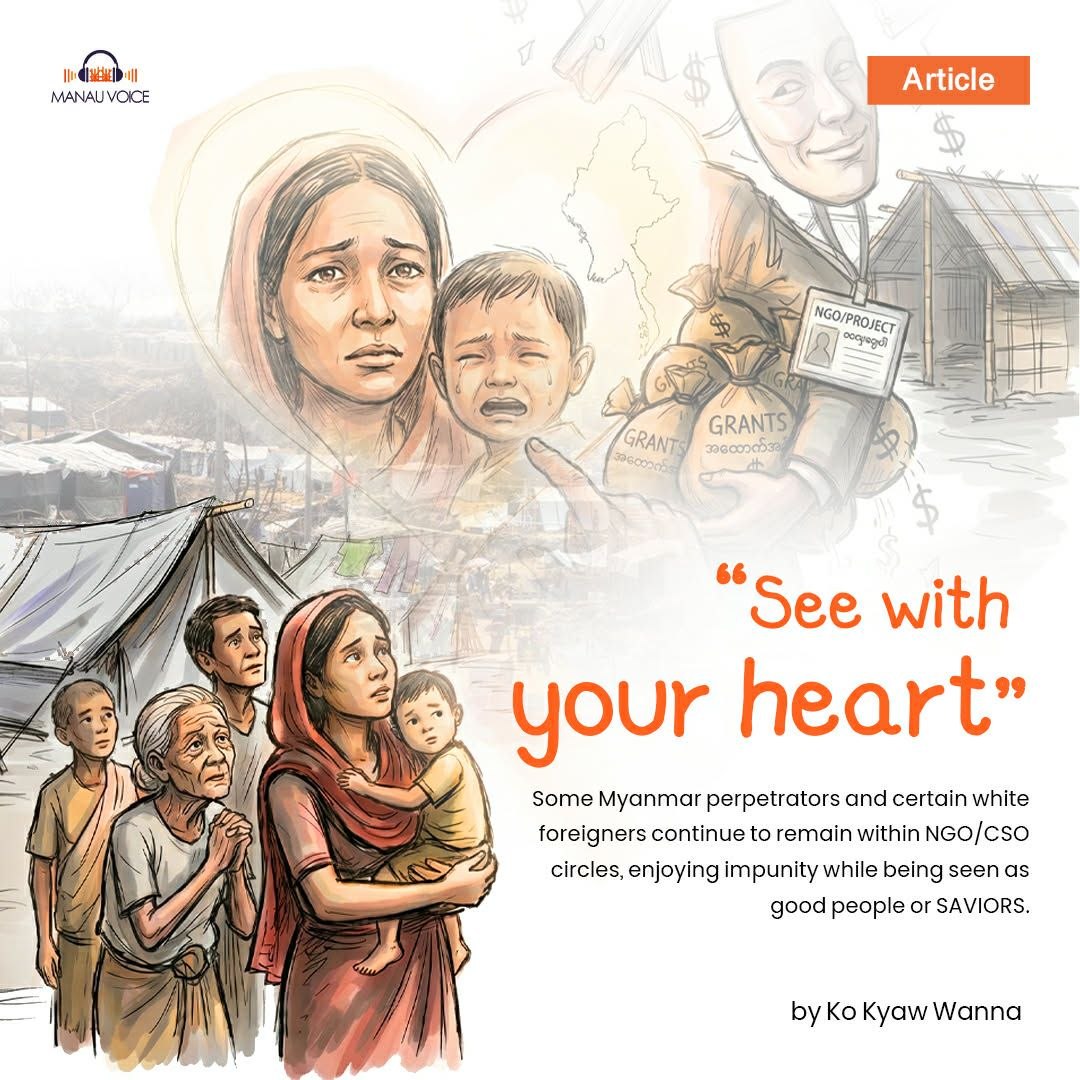
Some of these organizations are not content with merely living comfortably off their work using the poor and the displaced as justification. They go further, mistakenly and arrogantly viewing themselves as the “SAVIORS” of the poor and the suffering. This mindset is shared by certain Myanmar nationals and white Western expatriates alike.
Consider the following reality: Some Western men who come with projects to protect human rights in Myanmar regularly enter into consensual sexual relationships with local, indigenous women in their operational areas, with no intention of long-term commitment or marriage. When their projects end, they simply abandon these young women and return to their home countries without a second thought.The innocent young women are then left humiliated and diminished in the eyes of their parents, siblings, relatives, and communities. This exploitation is not isolated; it occurs repeatedly.
Because of such abuses by people in positions of power within the humanitarian sector, the UN and partner organizations in Myanmar established a PSEA (Prevention of Sexual Exploitation and Abuse) Network and uphold a zero-tolerance policy. Beyond that, official guidelines from major international bodies like the UN Refugee Agency (UNHCR) explicitly prohibit aid workers from sexually exploiting refugees, mandating a strict victim-centered approach that prioritizes immediate protection and comprehensive care.
Furthermore, the international humanitarian news organization “The New Humanitarian”, in its report “Then and Now: 25 Years of Sexual Exploitation and Abuse,” points out that due to the severe imbalances of power between aid providers and the refugees they serve, this kind of sexual exploitation has been cycling like a chronic disease across the globe for decades.
Despite the existence of such policies and public commentary, some of these Myanmar and Western perpetrators continue to exist within NGO/CSO circles, treated as good people and saviors — enjoying impunity. Some human rights NGOs/CSOs and certain Myanmar nationals turn a blind eye to these matters and even label the perpetrators as “good people.”
Just as some powerful foreigners and senior figures exploit their positions in this way, a new layer of discriminatory behavior has also emerged among privileged youth toward one another.
[6/1/2026 7:25 PM] Hein Htet: To give another example: after the military coup of 2021, people from all walks of life, including youth, students, and CDM participants, either entered the jungle to take up arms or made their way to Mae Sot on the Myanmar-Thailand border in large numbers.
Among them, a segment of youth who understood the mechanics of the NGO/CSO sector successfully applied for project funding, established youth groups, and built dedicated spaces for activism and mutual support. Through these initiatives, some of these early arrivals secured international scholarships and advanced educational opportunities.
However, when the new waves of youth arrived at the border after the military council’s conscription law emerged in 2024, these earlier arrivals began saying that the newcomers “arrived later and are simply walking a path that was already paved,” and that those who left early in 2021 should not be compared to those who came after 2023. Yet, strangely, even these very people who speak this way are regarded by some youth as “capable leaders.”
Therefore, it is especially necessary to work in your organizations and professions with your HEART, rather than merely chasing money or fame under the guise of social work. It is essential never to forget why you came to stand where you are today. Without the poor and the displaced, there would be no work. We must never fall into the mistake of seeing ourselves as “SAVIORS”. When wrongdoing does occur, it is necessary that we speak up and take action.
I am writing this with the hope that genuinely socially beneficial organizations will emerge, not the kind that merely perform goodness for show.
Ko Kyaw Wanna