Photos
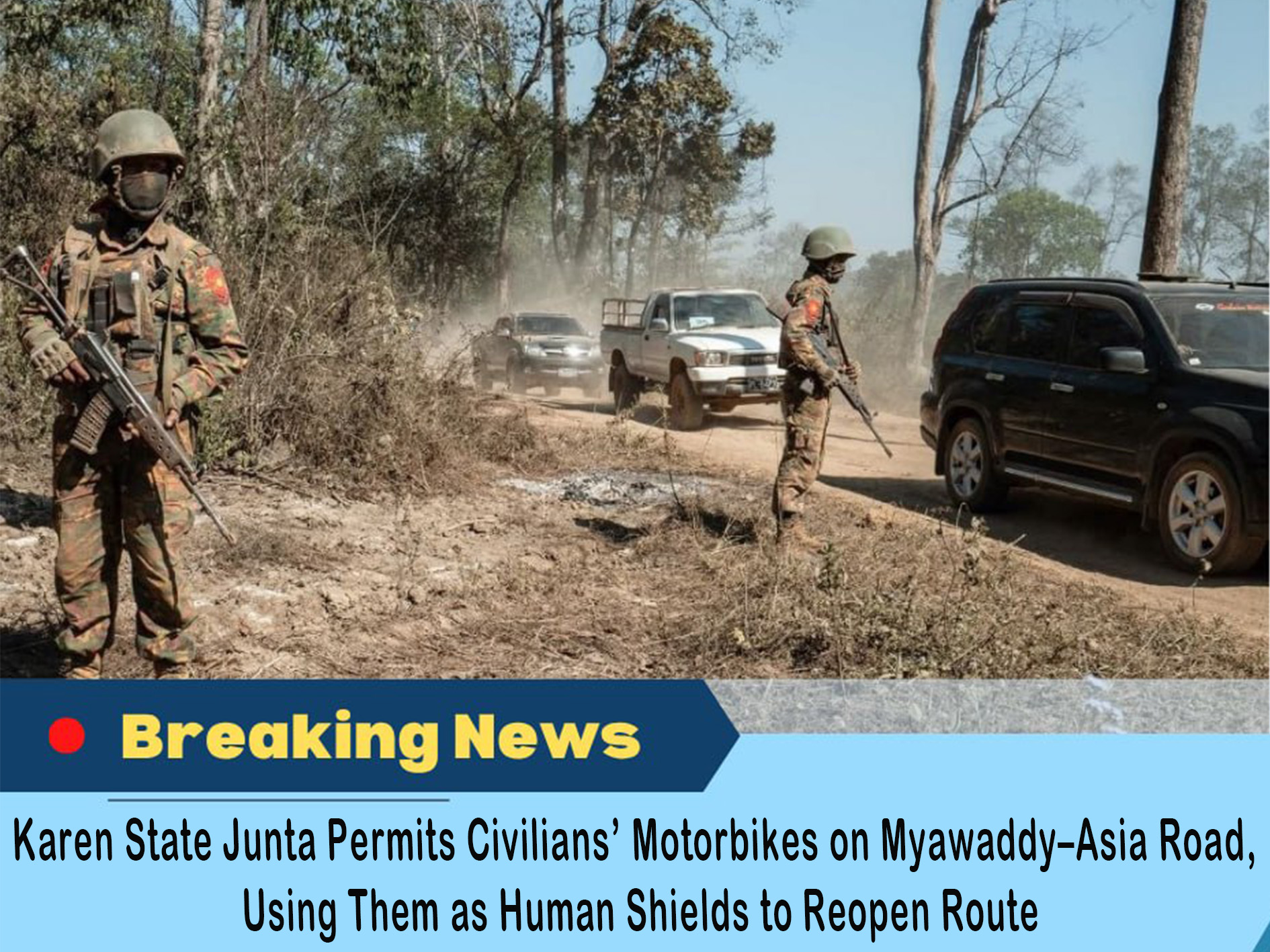
Karen State Junta Permits Civilians’ Motorbikes on Myawaddy–Asia Road, Using Them as Human Shields to Reopen Route
1 April, 2026
On the Thailand–Myanmar border, supporters of the military council in Karen State are circulating news that the Myawaddy–Kawkareik Asian Highway will be reopened on April 2, allowing local residents to cross again using their private motorbikes. This announcement is being framed as a restoration of movement for civilians, but it comes amid ongoing fighting and deep mistrust of the junta’s motives.
In addition, the Karen State military command has reportedly issued orders to its subordinate offices to mobilize people for a “road reopening ceremony” at the village of Lon Nya, near where the Asian Highway repair work is said to begin. The directive urges all local pro regime departments and township structures to attend the event, turning it into a show of force and political theater.
A local resident who spoke with media outlets described the plan cynically: “The state military leaders say they’ll hold the reopening ceremony in Lon Nya, chant paritta prayers on the Myawaddy side of the Asian Highway, and then send motorbikes down the road. That’s basically using civilians as human shields. If the Karen groups fire, the junta will blame them for targeting civilians—but people are too afraid to go; truck drivers are also scared to use the road.
At the same time, residents of Myawaddy are posting widely on social media that the Asian Highway is about to reopen and that they will finally be able to travel normally again. These messages reflect strong civilian desire for restored trade and movement, yet they also amplify the regime’s narrative while the reality on the ground remains highly unstable.
Currently, along the Kawkareik–Kyone Doe stretch, the junta’s troops are under constant harassment by the KNLA and allied forces, who conduct daily ambushes and guerrilla attacks in the area. In response, the regime has kept using heavy artillery and drones to shell nearby villages, continuing a pattern of collective punishment that has already forced repeated displacement.
So far, regarding these rumors that the Asian Highway will be reopened on April 2, the KNU (Karen National Union) and its armed wing, the KNLA, have issued no official statement or warning. There has also been no public comment or cautionary message from KNLA affiliated military affairs officials, leaving the local population without clear guidance on whether or when the road will truly be safe to use.
Karen State Junta Permits Civilians’ Motorbikes on Myawaddy–Asia Road, Using Them as Human Shields to Reopen Route
1 April, 2026
On the Thailand–Myanmar border, supporters of the military council in Karen State are circulating news that the Myawaddy–Kawkareik Asian Highway will be reopened on April 2, allowing local residents to cross again using their private motorbikes. This announcement is being framed as a restoration of movement for civilians, but it comes amid ongoing fighting and deep mistrust of the junta’s motives.
In addition, the Karen State military command has reportedly issued orders to its subordinate offices to mobilize people for a “road reopening ceremony” at the village of Lon Nya, near where the Asian Highway repair work is said to begin. The directive urges all local pro regime departments and township structures to attend the event, turning it into a show of force and political theater.
A local resident who spoke with media outlets described the plan cynically: “The state military leaders say they’ll hold the reopening ceremony in Lon Nya, chant paritta prayers on the Myawaddy side of the Asian Highway, and then send motorbikes down the road. That’s basically using civilians as human shields. If the Karen groups fire, the junta will blame them for targeting civilians—but people are too afraid to go; truck drivers are also scared to use the road.
At the same time, residents of Myawaddy are posting widely on social media that the Asian Highway is about to reopen and that they will finally be able to travel normally again. These messages reflect strong civilian desire for restored trade and movement, yet they also amplify the regime’s narrative while the reality on the ground remains highly unstable.
Currently, along the Kawkareik–Kyone Doe stretch, the junta’s troops are under constant harassment by the KNLA and allied forces, who conduct daily ambushes and guerrilla attacks in the area. In response, the regime has kept using heavy artillery and drones to shell nearby villages, continuing a pattern of collective punishment that has already forced repeated displacement.
So far, regarding these rumors that the Asian Highway will be reopened on April 2, the KNU (Karen National Union) and its armed wing, the KNLA, have issued no official statement or warning. There has also been no public comment or cautionary message from KNLA affiliated military affairs officials, leaving the local population without clear guidance on whether or when the road will truly be safe to use.